
Prevention/Promotion
Prevention/Promotion programs use methods or activities to reduce or deter specific problem behaviors such as bullying, gang involvement or substance abuse; or to promote positive behaviors and outcomes. Prevention/Promotion programs that aim for promoting positive behaviors can focus on employment skills, life skills, or be pro-social activities which are designed to encourage youth to behave in ways that benefit others. Some Prevention/Promotion can touch on different areas of promoting positive behaviors while working to prevent the problem behaviors within the same program. Prevention/Promotion programs can also utilize 40 Developmental Assets programming which focus on 40 research-based, positive qualities that influence young people’s development, helping them become caring, responsible, and productive adults. Programs in this category will meet with youth in an ongoing basis over a specific period of time.
evaluating prevention/promotion programs
As part of our yearly evaluations for Community-based Juvenile Services Aid funded programs in fiscal year 2025, the JJI, in partnership with the NCC, developed evaluation matrices to categorize important outcomes for each program type evaluated. The following categories describe the important program outcome indicators for prevention/promotion programs. These categories can be used to assess the standing of a program in terms of whether it is successfully applying best practices and meeting expectations or common goals for such programs.
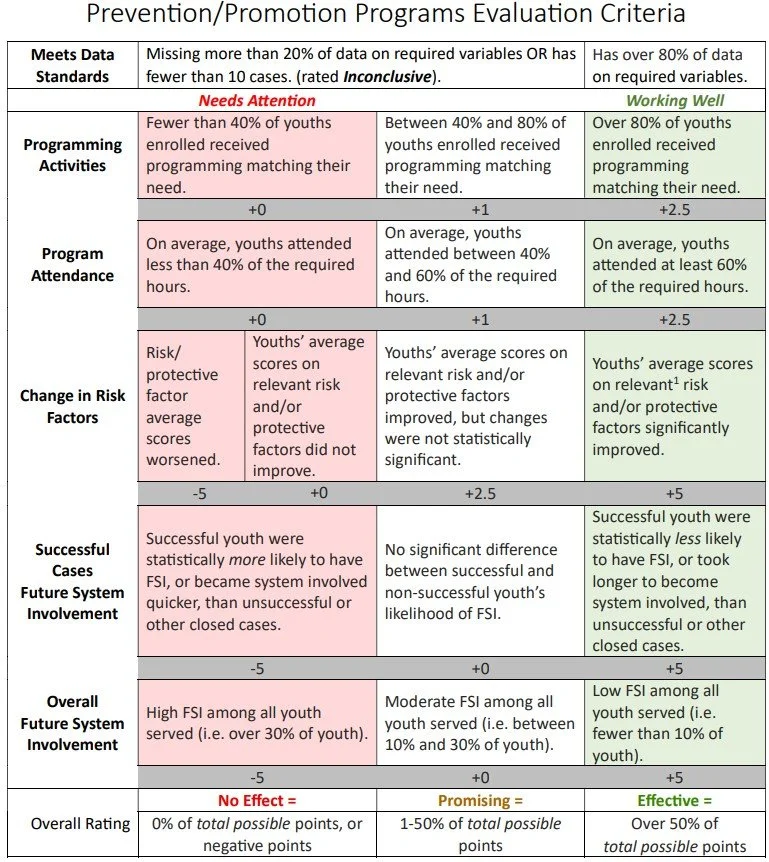
Evaluation Framework
Any program assessment must start by reviewing what data is available on processes and outcomes. Incomplete data or small sample sizes (i.e. few client cases) increase the risk of error in analysis. Shreffler and Huecker (2023) describe what Type I and II errors are – with high risks for error we might fail to identify a positive impact that’s occurring or falsely state the program was effective when it wasn’t. Small sample sizes run the risk of an outlier (one or two cases with unique, or very low/high values in an outcome) skewing the results.
A major goal of the Community-based Juvenile Services Aid (CBA) and Juveniles Services Commission Grant (JS) funding is to provide community-based services for juveniles who come in contact with the juvenile justice system and prevent youth from moving deeper into the system. CBA/JS funded programs are evaluated on how effective they are at preventing future system involvement (FSI) after youth are discharged from the program. FSI is evaluated in two ways – 1) comparing FSI between successful cases and unsuccessful cases and 2) overall FSI for all youth served. Evaluating these metrics gives a program the overall picture of FSI for the youth they come into contact with and helps programs more deeply understand how successful completion or discharge from their program impacts FSI of youth.
The following is a brief review of some of the existing literature related to prevention/promotion programs to further explain the importance of evaluating outcomes in rating program effectiveness.
Brief Literature Review
Researchers have spent decades learning the direct and indirect factors associated with delinquency, and many of these factors are susceptible to intervention and can be easily targeted through early intervention efforts. One study examined risk factors associated with future system involvement of youth served by prevention programs in Florida and found that school-related factors (achievement/ engagement) were the most impactful risk factors of future system involvement, followed by family and relationship factors, aggression, substance use, and attitudes/behaviors. They also found that successful completion of prevention programming reduced odds of future system involvement by 32% (Sheppard et al., 2024). Thus, programs that focus on early interventions to bolster protective factors and reduce malleable risk factors in youth play an essential role in the goal to reduce youth system involvement.
Prevention programs are often grouped into three types by target population and timing:
Universal – programs focused on general populations of youth (or entire communities) to bolster protective factors and reduce risk factors broadly.
Selective – programs focused on specific groups who are known to have higher levels of risk factors or less protective factors against delinquency
Indicated – programs focused on youth already engaged in some delinquent/problem behaviors
These programs ensure all youth with varying levels of risk and system contact are being served effectively and provided access to positive experiences and growth opportunities.
Multiple comprehensive analyses of prevention programs have been conducted, and these programs have been found to have overall positive effects on youth (lower delinquency or problem behaviors; (Fagan, 2021; Farrington et al., 2017). However, these positive effects tend to be small or modest (Beelmann & Lösel, 2021; de Vries et al., 2014), with the effects of programs largely depending on the program’s characteristics and implementation.
Early work by Nation and colleagues (2003) identified a set of principles associated with effective prevention:
“There were five principles associated with program characteristics: Programs (a) were comprehensive, (b) included varied teaching methods, (c) provided sufficient dosage, (d) were theory driven, and (e) provided opportunities for positive relationships. Two principles were specifically related to matching programs to the target group: Programs (a) were appropriately timed and (b) were socioculturally relevant. Finally, there were two principles related to program implementation and evaluation: Programs (a) included outcome evaluation and (b) involved well-trained staff.”
Other researchers have echoed the importance of multimodal, comprehensive approaches and sufficient dosage in effectively preventing delinquency (Beelmann & Lösel, 2021; de Vries et al., 2014). Overall, programs that target the needs of the youth in terms of multi-faceted programming and intensity are more likely to prevent problem behaviors.
For additional resources or to access articles referenced above, contact the JJI at unojji@unomaha.edu.
additional Resources

jcms guides
*You can find more JCMS training materials and videos on the Trainings & Tools page.
resources for prevention/promotion
The OJJDP publishes literature reviews on what works for juvenile delinquency prevention and intervention, including prevention programs. Specifically, the OJJDP has published literature reviews on the following topics/program types and their outcomes:

The OJJDP publishes literature reviews on what works for juvenile delinquency prevention and intervention, including prevention programs.
Specifically, the OJJDP has published literature reviews on the following topics/program types and their outcomes:
Job training (2010)
Gang prevention (2014)
Positive youth development (2014)
The Annie E. Casey Foundation website contains multiple resources and guides for youth prevention programming, including the following:
Resources pertaining to Positive Youth Development
Keys to Your Financial Future – program curriculum that teaches youth about financial responsibility
An action guide for “Creating Equitable Ecosystems of Belonging and Opportunity for Youth”

The CDC (2016) published a comprehensive technical package describing strategies to reduce youth violence and delinquency.
